
Only 21% of paid-search headlines from premium multi-brand retailers in the UAE carry any brand equity. The remaining 79% lead with a discount (42%) or say nothing distinctive at all (37%). That is the main result of the Brand Strategy Alignment Benchmark, an analysis of 132 public Google Ads headlines from ten UAE retailers that sell premium brands, collected between April and October 2026.
The retailers in this study advertise some of the most carefully built brands in the world: Swiss watches, flagship smartphones, performance sportswear, high-end cycling components. In four out of five headlines, the equity those brands spent decades building is absent at the exact moment a customer first meets them in search.
Key findings
- 21% brand-led, 42% discount, 37% generic. Across all premium retailers studied, only one headline in five used the brand, its craft or its distinctive promise.
- Electronics retailers: 0% brand-led. Three multi-brand electronics chains advertising flagship phones, laptops and cameras did not run a single brand-led headline. 58% of their headlines led with a discount — more than the outlet discounter we used as a calibration point (57%).
- Discounting reached luxury. A watch retailer selling Swiss brands led with “up to 70% off” in 57% of its headlines, the same rate as the outlet discounter.
- Discipline is possible at scale. An authorized dealer of luxury watches ran 100% brand-led headlines and no discounts at all, while also being the highest-volume advertiser in the study, with roughly 700 ads over six months.
What we measured
For every retailer, we collected the text headlines of ads shown in the UAE, using the public Google Ads Transparency Center. Each headline was coded into one of three registers:
- Brand-led: the headline carries brand equity. A named brand as the hero, or concrete craft, material, heritage or authenticity content (“carbon frames”, “Swiss made”, “Fenix 8, sapphire and titanium”).
- Discount: the headline leads with price, markdown or urgency (“up to 50% off”, “best deals”, “limited time”).
- Generic: neither. Template copy that could belong to any competitor (“[brand] shop online collections UAE”, “order now”, “online shopping”).
Words like “premium” or “official” on their own did not count as brand signals. They only counted when backed by concrete brand or craft content. The full method is at the end of this page.
The result: discipline, not category
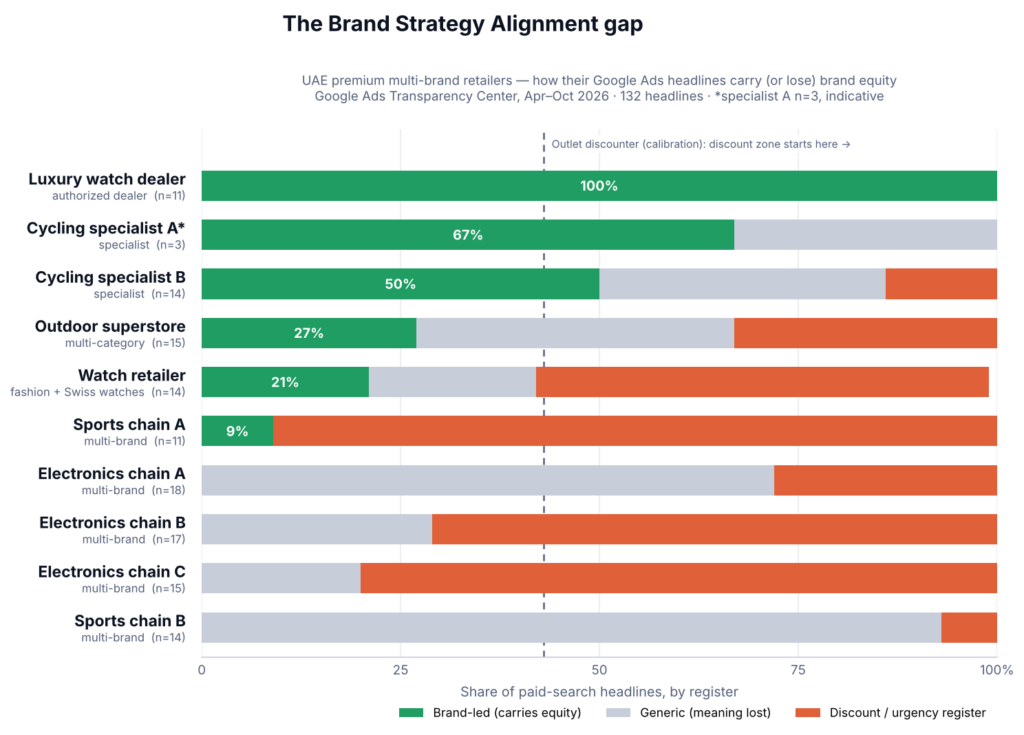
The most useful finding is what predicts whether a retailer keeps its advertising on-brand. It is not the category, and it is not how premium the goods are.
At one end, the authorized luxury watch dealer named the brand in every headline and spoke about craft and heritage. Two specialist cycling retailers came next, leading with brands and product craft in 50–67% of their headlines.
At the other end, three electronics chains and two large sports chains ran almost no brand-led headlines at all. Their advertising was either pure markdown or interchangeable template copy.
| Retailer type | Brand-led | Discount | Generic |
|---|---|---|---|
| Authorized luxury watch dealer | 100% | 0% | 0% |
| Cycling specialist A* | 67% | 0% | 33% |
| Cycling specialist B | 50% | 14% | 36% |
| Outdoor superstore | 27% | 33% | 40% |
| Watch retailer (fashion + Swiss) | 21% | 57% | 21% |
| Sports chain A | 9% | 91% | 0% |
| Electronics chain A | 0% | 28% | 72% |
| Electronics chain B | 0% | 71% | 29% |
| Electronics chain C | 0% | 80% | 20% |
| Sports chain B | 0% | 7% | 93% |
*Specialist A had only 3 headlines, below our inclusion threshold of 10. Shown as indicative only.
The pattern is consistent: specialists and authorized dealers hold the brand; large multi-brand chains let it go, regardless of what sits on their shelves. One example makes it concrete. The same premium smartwatch brand appeared in the sample as a spec-led hero at one retailer, and as “up to 40% off” at another. At the outdoor superstore, it appeared both ways within the same account. The brand did not change. The discipline did.
Two ways brand meaning gets lost
The data shows two distinct failure modes.
Discount capture (42% of headlines). The brand is reduced to its price: “big discounts on [brand]”, “up to 50% off [brand] shoes”, “Swiss watches, up to 70% off”. The brand name is present, but only as the object of a markdown. For a premium brand, every such impression teaches the market to wait for the sale.
Generic flattening (37% of headlines). No discount and no error, just template copy that carries no brand at all. The same phrase is repeated across every brand in the catalogue, with the brand name dropped into a slot. This failure mode is the quieter one and the more dangerous, because nothing looks wrong. A manual review rarely flags it. It is the cumulative loss of meaning we describe as meaning entropy: each headline is a little more generic than the brand behind it, and no single one looks like damage.
Why this happens
None of these retailers set out to dilute the brands they sell. The dilution comes from how paid-search copy is produced: by junior specialists, agencies and automated tools, at volume and under deadline, far from the brand strategy written down months earlier. Nobody checks each headline against that strategy before it goes live, because at this volume nobody can. We cover this bottleneck in detail in keeping ad copy on-brand at scale.
A secondary signal in the data points to the same cause. Two of the retailers ran ads targeted at the UAE whose copy was written for another market: UK store addresses and a UK credit product in one case, a Qatar-specific ad in another. That is a mismatch between the audience set in the campaign and the copy written for it, and it has the same root: no check reconciling the two before budget is spent.
What would change the number
The retailers at the disciplined end are not more talented. They have a narrower, clearer idea of what each brand is, and they apply it consistently. That consistency is exactly what breaks when a catalogue holds hundreds of brands and copy is produced faster than anyone can read it.
More detailed brand guidelines do not solve it on their own: a document describes the brand but cannot check a headline. Neither does reviewing harder, because manual review is the bottleneck that volume already broke. What closes the gap is a check at the point of publication: each piece of copy measured against the brand’s declared strategy — its positioning, its audience, what it is and is not — with the misalignment flagged before the ad goes live. The check has to be independent of whoever or whatever wrote the copy; a tool that generates copy cannot neutrally grade its own output. This is the difference between brand consistency and brand compliance: consistency is the goal, compliance is the enforcement.
For the broader picture of why consistency breaks at scale, see Brand Consistency at Scale.
Methodology
Source. Google Ads Transparency Center, public data only, region filter set to the United Arab Emirates, April–October 2026. No account access, no performance data, no private brand strategies and no client information were used.
Sample. Ten multi-brand retailers selling premium brands in the UAE, across sports, cycling, outdoor, electronics and watches, plus one outlet discounter as a calibration cohort. Only multi-brand retailers were included; a brand advertising itself is a different dynamic. 132 unique text headlines in the premium cohort, 7 in the calibration cohort.
Coding. Each headline was coded against a lexicon fixed before coding began. Identical headlines were counted once per advertiser. Shopping and image ads were logged but excluded from the headline metric. Generic words such as “premium” and “official” were not counted as brand signals without concrete brand or craft content.
What we did not do. We did not use or describe any retailer’s private strategy. The only assumption is the public fact that these retailers sell premium brands. We measured the language of their ads, not the intent behind them.
Limitations. The sample is purposive, not random. One retailer fell below the 10-headline threshold and is shown as indicative. Percentages describe the set of headlines observed, not impression-weighted exposure. Retailers are anonymized; the benchmark describes patterns, not individual companies.
FAQ
What is the Brand Strategy Alignment Benchmark?
It is original research by Vashor measuring how well premium retailers’ paid-search ads reflect the brands they sell. The 2026 edition analyzes 132 public Google Ads headlines from ten UAE multi-brand retailers and classifies each one as brand-led, discount or generic.
How many premium retail ads carry brand equity?
In this study, 21% of headlines were brand-led. 42% led with a discount and 37% were generic template copy with no brand content.
Do luxury retailers discount in their ads?
Some do. A watch retailer selling Swiss brands led with “up to 70% off” in 57% of its headlines. An authorized luxury watch dealer, by contrast, ran no discount headlines at all.
What predicts whether a retailer stays on-brand?
In this sample, the type of retailer mattered more than the category. Specialists and authorized dealers kept their ads brand-led; large multi-brand chains did not, regardless of how premium their products were.
Research by Vashor. Vashor checks ad copy against a brand’s declared strategy before it is published — an independent check, not a content generator. See how Vashor checks your content →